
String instrument rentals
Violin, viola, cello, bass
Free school delivery
Free size swaps as they grow
Violin, viola, cello and double bass for students in school orchestra across Connecticut and New York. Whatever your child was assigned, it gets set up on our bench in Norwalk before it goes out.
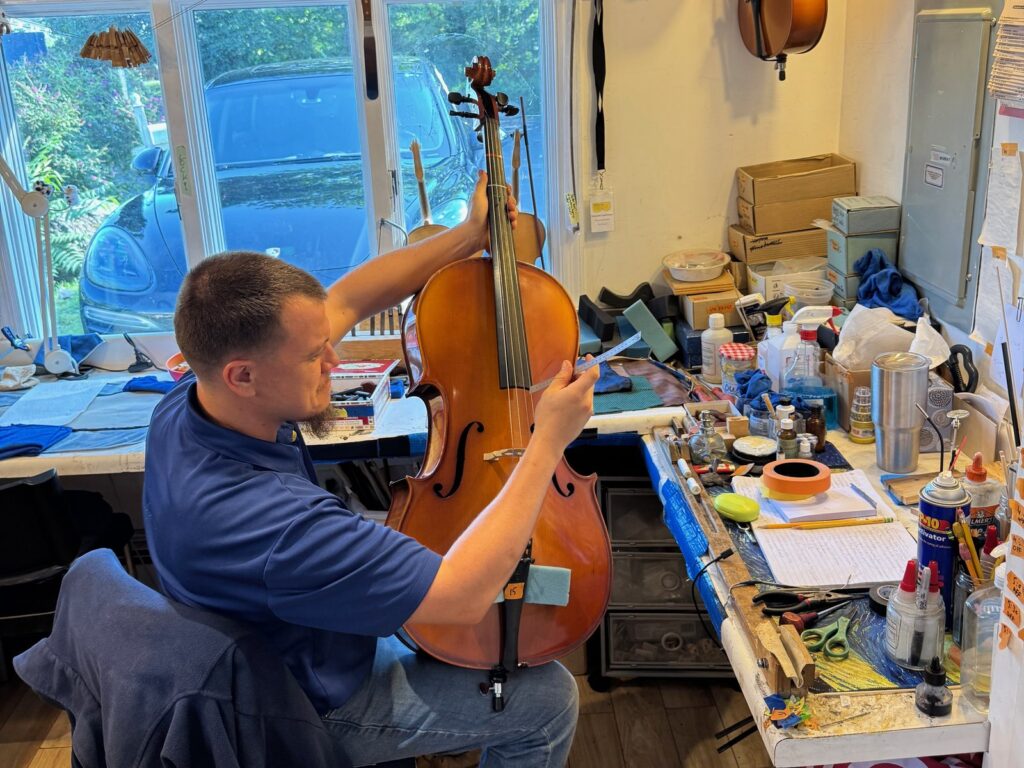
Set up on our bench
Bridge fitted, sound post set, string height adjusted. Every label, every time.
Free school delivery
Instruments arrive at the school in the fall, across Connecticut and New York.
Free size swaps
String students grow. Exchange for the next size at any time, no extra fee.
Renting can count toward owning
We have options for applying what you have paid in rental fees toward a purchase. Ask us.
Every instrument is set up before it leaves
Setup is the work done to an instrument after it’s built and before anyone plays it. Most people don’t think about it, and it affects how an instrument plays more than the price does.
Instruments arrive from the workshop with the bridge unfitted and the sound post loose. Somebody has to do that work, and it takes a trained luthier. Ours are on staff, and they do it to every instrument we rent, at every label.
- The bridge is fitted and shaped to that specific instrument, curved enough that a student can bow one string at a time
- The notches are cut to the right depth. Cut them too deep and they choke the sound
- The sound post is set behind the bridge foot, where it carries vibration through the body
- String height is set low enough for a child to press the strings down comfortably
- Seams are checked and sealed, and the instrument is played to make sure nothing buzzes
- Strings are checked. Nothing goes out on rusted strings
- The bow is checked for straightness and a full head of hair, not half
- Good rosin is included, and we check the case, including the zippers
A good instrument that’s badly adjusted plays worse than a modest one that’s been set up right. So every instrument gets set up here before it goes out, whatever it costs to rent.
Expect to retune it. We tune every instrument before it leaves, but strings settle, and it’ll need tuning again by the time it reaches school. That’s normal for string instruments. Your teacher can help, and so can we, free, any time you ask.
Our string labels
Having a choice at all is unusual in instrument rental. We carry three labels on violin and viola, four on cello and two on bass, so you decide how much to spend and how much tone you want back, rather than taking whatever happens to be on the shelf. We will suggest a starting point, and as a student gets more serious we will tell you when moving up is worth it.
White Label
We’ve spent twenty years learning which workshops build a student instrument worth renting. Ours come from a small number of makers whose work we know, and nothing goes into the fleet unless it clears the standard we set.
The standard: a violin has to sound like a violin, play like a violin, look like a violin, and be safe and easy under a child’s hand. The cheap violins sold online usually manage one of those four.
Then it comes to our bench and gets the same setup as everything else we rent.
DELUXE
Black Label
Kenneth Kuo works directly with the makers who build these. He specifies the wood, how thin it gets carved, the varnish and the finish, and he checks every instrument against what he asked for before it joins the fleet.
On violin and viola the materials are the same as White Label. Spruce top, maple back, ribs and scroll, ebony fingerboard. Building one takes considerably longer than a stock instrument, and what you are paying for is the maker. Someone who has been building for decades starts with a better grade of wood, takes the plates thinner in the places that open up the sound, and gives the fitting, the glue, the varnish and the strings the attention a one-day build cannot.
You get more tone to work with, which a student starts to hear once they’re practicing regularly.
PREMIUM
Euro Label
Made in workshops across Europe in the 1970s and 1980s, from wood that had already been aging before it was worked. Aged wood is more stable and moves less with the seasons.
Most rental companies don’t carry European instruments at all. Ours come through workshop relationships Ken has built over twenty years, and the supply is limited to what those workshops have aged and ready. If you want one, ask early.
Choosing a label
Side by side, this is what the money buys.
On cello and double bass, construction also differs between labels. See those pages for the detail.
Which one you pick comes down to your budget, how long your student has been playing, and how much handling the instrument is likely to take in a school year. Call us and we’ll help you work it out. If you start on one label and want to move up later, you can do that mid year without a penalty.
Every label gets the same free adjustments, the same free tuning help, the same size exchanges and the same insurance options.
The instruments
Violin and viola come in White, Black and Euro. Every violin and viola we rent is carved from solid wood at every label.
Cello comes in White, Red, Black and Euro. Red Label sits between White and Black and is built differently from either. Details are on the cello page.
Double bass comes in White and Euro. Three quarter size is what most adult players use, and we stock down to 1/10 for younger students.


What’s included
Every string rental comes with the instrument, a bow, a case and rosin.
Also free:
- Delivery to schools across Connecticut and New York in the fall
- Exchange for the next size up as your child grows
- Adjustments and tuning help for as long as you rent
- Options for applying rental payments toward a purchase, if you decide to buy
String rental questions
Answered by the luthiers who work on these every day. Browse all Ask a Luthier answers.
Choosing and sizing
What size violin does my child need?
Violins run from 1/16 up to full size, and it is arm length that decides, never a chart of ages and heights. Children come in every shape, and the final call on size belongs to your child's teacher. The quick check: in playing position, your child's fingers should curl over the end of the scroll with a slight bend in the elbow. When in doubt go smaller, and better yet, have a teacher or a shop of working musicians size them in person. It takes two minutes.
Why are violas measured in inches instead of fractions?
Because there is no standard "full size" viola. Violins scale up to a fixed 4/4 and stop. Violas are built in a continuous range of body lengths, and a 15" and a 16" are both adult instruments. They simply sound different, the larger being deeper and richer.
Can we swap to a bigger size as our child grows?
Yes, at no charge, as many times as growing requires, and it is one of the main reasons to rent a string instrument rather than buy one.
How do I know when my child has outgrown their instrument?
Two answers for two kinds of outgrowing. Physically: when the teacher says it is too small, move up, a free size swap for our string renters. Musically: put a better instrument in your child's hands, and if they can hear and feel the difference and the budget allows, it is time to upgrade. If they cannot, keep what you have.
The director wants my violinist to switch to viola. Is that starting over?
No, and it happens so often it is practically a tradition: most of what your child knows transfers directly, and the genuinely new work is a few weeks of alto clef. School orchestras are chronically short of violists, so somewhere around a student's fifth, sixth, or seventh year of violin, a director or teacher leans over and says: have you thought about the viola? It is meant as a compliment. It usually is one.
Should we rent or buy our child’s first instrument?
Rent, in almost every case: beginners can't yet handle an instrument safely, children outgrow sizes and switch instruments, and renting turns those surprises into a phone call instead of a buying mistake. And we would say that even if we didn't rent instruments.
Can we move up to a better instrument partway through the year?
Yes, and there is no penalty for it. There is a change of instrument form for exactly this. You pay the difference in the monthly rate for the months remaining in your rental, the insurance is recalculated for the new instrument, and that is the whole of it. No fee, and nothing lost from what you have already paid.
How our instruments are made and set up
Why does one violin cost three times another?
The wood is the same. A White Label violin and a Black Label violin are both spruce, maple and ebony, and there is no cheaper species in the less expensive one. What you pay more for is the maker’s time, how carefully the wood was selected within that species, the varnish, the glue, the strings it arrives with, and the experience of the person who carved it. A White Label violin is built in a day or two by a workshop we have bought from for years. A Black Label takes about a week, and is built to a written specification from Kenneth Kuo.
What does “set up by a luthier” actually involve?
Setup is the hand work done to a string instrument after it is built and before anyone plays it. The bridge is carved and fitted to that individual instrument, the sound post is positioned inside the body, the string height is adjusted, and the whole instrument is checked and played before it goes out. An instrument that has not been through this is not ready to play, even when it looks finished in the box.
Are the violins sold online for under a hundred dollars any good?
No, and the reason is worth understanding before you spend the money. We hold every instrument to four requirements before we will stock it: it has to sound like a violin, play like a violin, look like a violin, and be safe and easy under a child’s hand. The instruments sold online for twenty or fifty dollars meet one of the four. They look like a violin.
My child’s teacher is skeptical of an instrument with no brand name on it.
That is a reasonable instinct, and we would rather a teacher raised it than said nothing. Instruments do turn up in school music rooms that arrived from an online seller and cannot be played properly, and a teacher who has spent a term working around those has good reason to look twice at a name they do not recognize. The answer is not to argue about it. Bring the instrument in, or ask the teacher to call us, and one of our musicians will play it in front of you. If something is wrong we will correct it or exchange it. If it is fine, you will hear that for yourself.
Is a laminated cello a worse cello?
It is a different cello, built for different conditions, and for a student in the first years it is often the better one to have. Laminated means several thin sheets of wood glued together rather than one solid piece carved to shape. The benefit is strength. A laminated cello is much less likely to crack. The tradeoff is in the sound. A laminated cello is mellower and more reserved than a carved one, because there are multiple sheets of wood with glue between every one of them, and glue dampens sound.
What is a luthier, and why does it matter for a rental?
A lot of people just call us the violin doctor, and that is exactly what a luthier is: someone trained to build, repair, and care for string instruments. The word is reserved for strings. You would not call a piano technician or a clarinet repair tech a luthier. It comes from the lute, one of the oldest instruments in the family, and the trade has been passed down since the instruments themselves evolved from it into the violin, viola, cello, and bass.
Renting and looking after it
How do I tune my child’s violin without wrecking it?
Use the fine tuners, the small screws at the tailpiece. They move the pitch a little at a time and are very hard to overdo. The strings are G, D, A, E from lowest to highest, and a clip-on tuner or a phone app tells you where you are. (The app our own staff reach for is ClearTune, but any decent tuner works.)
Why did my instrument arrive out of tune?
Because it is a string instrument, and that is what they do. We tune every instrument before it leaves the shop, but strings stretch and settle, wood moves with temperature and humidity, and the instrument travels. By the time it reaches the school it will need tuning again. That is the nature of a string instrument rather than a sign that anything is wrong.
The bridge fell off my child’s violin. What do I do?
Loosen the strings slightly, lay the instrument in its case, and bring it in. Don't stand the bridge back up yourself, and don't let anyone else improvise it: resetting is quick, routine work at our counter, and a fallen bridge almost never means anything is broken.
Does winter really damage instruments?
Yes. Dry winter heat shrinks the wood, which means slipping pegs, constant tuning drift, open seams, and in the worst cases a cracked top. The fix is cheap: a humidifier in the room where your child practices from December through March, distance from radiators and parked cars, and an early visit if a seam opens. Winter is our busiest repair season, and most of what comes in was preventable.
Will I be charged for normal wear and tear?
No, not for normal wear: strings wearing out, rosin used up, bow hair breaking strand by strand, a case zipper giving out. That is expected, and it is never charged to you. Damage is different: dents, cracks from drops, a broken bow, carved initials. We always tell you which side of the line we think something sits on before any chargeable work happens, and the insurance exists for the genuine accidents and the gray areas.
What happens if my child quits after a few months?
Then you return the instrument. That is the whole point of renting instead of buying, it happens in every school year, and nobody here will make it awkward.
Ready to rent?
Pick your instrument above to start, or call and we’ll walk you through it. Nothing is charged until we confirm.