
Cello rentals, from a first lesson to the concert stage.
School-year rental
Short-term available
Sizes 1/16 to 4/4
The cello holds a particular place here, because our founder is a cellist. That is why the cello line runs to four labels where the violin has three. Every cello we rent is set up on our bench in Norwalk before it goes out.

Chosen by a cellist who’s played on the world’s great stages.
Kenneth Kuo trained under world-renowned cellists at Juilliard and Yale, winning the Aldo Parisot Prize, and has since recorded several best-selling cello albums. He also designs and manufactures string instrument components: he invented the Tonal Tailpiece, which is played by principal cellists of major American orchestras. Our Black Label cellos are built to his specifications, our White Label cellos are chosen against a standard he set, and every cello we rent is set up here in Norwalk before it goes out.
Juilliard & Yale · Aldo Parisot Prize · Concert cellist and instrument designer
Our four cello labels
What changes between labels is the grade of wood the maker starts with, how the cello is built, what the maker does with the extra days on the bench, and how much tone you get back. Most shops rent you one student cello. We’d rather you picked. Every one is set up in-house before it goes out. More about our string instruments and labels.
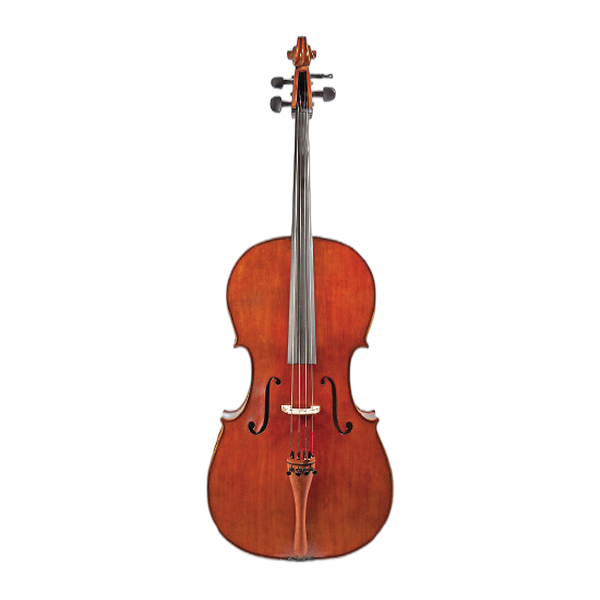
White Label
We buy these from a small group of workshops we’ve worked with for twenty years, and nothing goes into the fleet unless it clears the standard we set: it has to sound like a cello, play like a cello, look like a cello, and be safe and easy under a child’s hand. Our most widely rented cello, and the one most families choose for the first year or two. Construction varies by maker.
Red Label
Red Label sits between White and Black, and it is built differently from either: a solid carved spruce top over a laminated back and ribs. The solid top is where the sound is made, and the layers strengthen the ribs and back. More tone than White Label, more resilience than a fully carved instrument. A varnish between durable and oil finish keeps it sturdy while opening up the sound, with a solid ebony fingerboard and a flamed wood pattern usually found on more expensive instruments. We would typically suggest it once a student has a year of playing behind them.
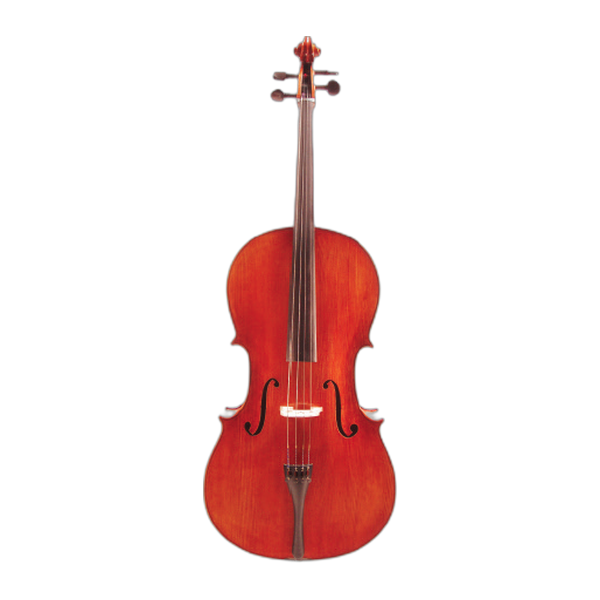
DELUXE
Black Label
We have these custom built for us. Kenneth Kuo specifies the wood, how thin it is carved, the varnish and the finish, and checks each cello against what he asked for before it joins the fleet. Carved from solid wood, top and back, with flamed maple back and ribs, a spruce top, an aged maple bridge and a solid ebony fingerboard. Building one takes considerably longer than a stock cello, and what you are paying for is the maker. Someone who has been building for decades takes the plates thinner in the places that open up the sound, and gives the fitting and the oil varnish the time they need.
PREMIUM
Euro Label
We collect these. Most rental companies do not carry European instruments at all. These were built in European workshops in the 1970s and 1980s, from wood that had already been aging before it was worked, so it aged naturally rather than being finished to look old. Carved from solid wood. Our supply is limited and does not restock on demand, so if you want one, ask early.
Not sure which to choose?
Choose White Label if you are watching the budget, or if your student is still learning to handle an instrument carefully. A cello takes more knocks than any other string instrument in a school year, and this is the one you would rather that happened to.
Choose Red Label if you want more tone than the entry cello gives without giving up the resilience.
Choose Black Label if your student is a few years in and practicing seriously, and you can keep the instrument somewhere with reasonable humidity.
Choose Euro Label if your student is auditioning or competing and wants the best we rent for the school year.
These are suggestions rather than requirements. Some families start higher up the range from day one, and some move up once a student gets serious. Either way, tell us what you are thinking and we will help you get there.
Solid and laminated cellos
Cellos get built two different ways, and it is worth knowing which one you are getting. A laminated cello is built from several thin sheets of wood glued together rather than one solid piece carved to shape. The benefit is strength: a laminated cello is much less likely to crack. The tradeoff is in the sound. A laminated cello is mellower and more reserved than a carved one, because there are multiple sheets of wood with glue between every one of them, and glue dampens sound. Some players prefer that warmth and choose a laminated instrument deliberately.
Why the strength matters more than parents expect. A school cello lives in a soft case, gets carried by a child not much bigger than it is, rides in a car, and spends the winter in a heated house. A solid carved cello has to be kept between 45 and 65 percent humidity or the wood splits, the same way floorboards shrink and gap in a heated house over winter. Every winter we take in instruments where it was not. A laminated cello handles all of that far better, and for a young player without a hard case or a humidifier that is a real advantage.
Where the difference in sound shows up. Not on day one, and not in a beginning orchestra. It appears when a student starts drawing real weight through the bow and expects the instrument to answer, which is usually somewhere in the second or third year. Before that, most of what a listener hears is the player rather than the cello.
- White Label. Our most economical cello and the most widely rented. Construction varies by maker.
- Red Label. A solid carved spruce top, where the sound is made, with layers strengthening the ribs and back.
- Black Label. Carved from solid wood, top and back, and built to our own specification.
- Euro Label. Built in European workshops in the 1970s and 1980s.
None of that changes the setup. Bridge fitted, sound post placed, string height adjusted, seams checked. Every cello we rent gets that work regardless of how it is built. More on laminated cellos.
The founder’s promise
“These cellos are handpicked and adjusted by me for each student. No two are identical. Each has its own personality. I’m so proud of them that I’ll personally play for you on the cello of your choice, so you can hear exactly what it’s supposed to sound like. I guarantee no one has better cellos for the price.”
Kenneth Kuo
President, The Connecticut School of Music · BA Juilliard · MM Yale
Renting can count toward owning.
If you decide to buy a cello from us, up to 12 months of what you’ve already paid in rental fees can be applied to the purchase price, excluding tax and insurance. Renting through the growing years counts toward owning rather than instead of it. If your student moves on, you simply return it.
Up to 12 months creditable · Free size swaps as they grow · Ask us when you’re ready
What size cello does my child need?
Cello size is based on your child’s height and arm length, not just age. We stock every size from 1/16 to full. The safest approach is to let us or your child’s teacher size them.
We size cellos in person, and there is a reason no chart appears here: leg length, torso length, and arm reach all matter, children combine them in every way, and there are at least ten different cellos that all get called full size. Bring your student to their teacher or to us, and the right size takes two minutes.
Don’t want to guess? Bring your child to the Norwalk shop and we’ll size them for free in a couple of minutes. New York families: your child’s teacher can size them in class, or we’re glad to help by phone.
Students grow, so when it’s time for the next size up, string renters swap to the larger cello free of charge.
Everything your student needs to start.
Every cello rental arrives ready to play, no extra shopping trip required.
- The cello, set up in-house
- Bow with real horsehair
- Case
- Rosin
- Four adjustable fine tuners
- Name tag
The common cello mishaps, and how to avoid them.
Cellos are hardier than they look, but a few things trip up new families. None of these are disasters, and normal wear is expected.
Most common issues
- The bridge leans or falls. It’s held up by string tension, not glue. If it tips, stop and bring it in. Don’t force it back.
- Pegs slip in dry weather. Wood shrinks in winter heating. Use the fine tuners for small fixes and let us reset pegs.
- Cracks from dryness. Keep the cello away from radiators and out of hot cars; a room humidifier in winter helps.
- Bow warping. Always loosen the bow hair after playing. Leaving it tight bends the stick over time.
Easy habits that prevent them
- Store it on its side, bridge to the wall. Keeps anything from bumping the bridge out of place.
- Loosen the bow, wipe the rosin. A quick wipe after practice keeps rosin from building up on the strings.
- Mind the endpin. Retract it before putting the cello away so it doesn’t bend or scratch.
- When in doubt, bring it in. Small problems are quick fixes; ignored ones get expensive. Tuning and minor adjustments are free.
Hear Ken play the cello line.
Our founder demonstrates the tone and craftsmanship of the cellos your student rents.
Cello rental questions
Answered by the luthiers and technicians who repair these every day. Browse all cello questions.
The bridge fell off my child’s violin. What do I do?
Loosen the strings slightly, lay the instrument in its case, and bring it in. Don't stand the bridge back up yourself, and don't let anyone else improvise it: resetting is quick, routine work at our counter, and a fallen bridge almost never means anything is broken.
What is a luthier, and why does it matter for a rental?
A lot of people just call us the violin doctor, and that is exactly what a luthier is: someone trained to build, repair, and care for string instruments. The word is reserved for strings. You would not call a piano technician or a clarinet repair tech a luthier. It comes from the lute, one of the oldest instruments in the family, and the trade has been passed down since the instruments themselves evolved from it into the violin, viola, cello, and bass.
Does winter really damage instruments?
Yes. Dry winter heat shrinks the wood, which means slipping pegs, constant tuning drift, open seams, and in the worst cases a cracked top. The fix is cheap: a humidifier in the room where your child practices from December through March, distance from radiators and parked cars, and an early visit if a seam opens. Winter is our busiest repair season, and most of what comes in was preventable.
What size cello does my child need?
Cellos run from 1/8 up to full size, sized by height, arm reach, and torso length together, and the honest answer is that no chart can do it: bring your child to their teacher, or to a shop with a cellist behind the counter, and sizing takes two minutes.
How do I tune a cello?
The strings are C, G, D, A, lowest to highest. For everyday touch-ups, use the fine tuners on the tailpiece with a tuner app, and leave the pegs alone. Beyond that, the most useful thing we can tell you is what our founder, a concert cellist, tells parents at the counter: tuning is a skill that belongs to intermediate players, and that is by design. A beginner cannot tune a cello because they do not yet know what the notes should sound like. Learning to hear that is part of learning the instrument, and it is the teacher's job to hand it over at the right pace. Even the members of our own staff who are not string players use a tuner app for this; ClearTune is the house favorite.
Questions every rental family asks
Should we rent or buy our child’s first instrument?
Rent, in almost every case: beginners can't yet handle an instrument safely, children outgrow sizes and switch instruments, and renting turns those surprises into a phone call instead of a buying mistake. And we would say that even if we didn't rent instruments.
What happens if my child quits after a few months?
Then you return the instrument. That is the whole point of renting instead of buying, it happens in every school year, and nobody here will make it awkward.
Will I be charged for normal wear and tear?
No, not for normal wear: strings wearing out, rosin used up, bow hair breaking strand by strand, a case zipper giving out. That is expected, and it is never charged to you. Damage is different: dents, cracks from drops, a broken bow, carved initials. We always tell you which side of the line we think something sits on before any chargeable work happens, and the insurance exists for the genuine accidents and the gray areas.
Ready to rent a cello?
Start your school-year rental online, or request a short-term quote for a performance. One of our staff members will confirm the size with you before anything is charged.