
Trumpet rentals for school band in New York City and Connecticut.
School-year rental
Rent to own (A Line)
Free school delivery
Trumpets take a beating in a school band room, so the two things that matter are free-moving valves and a horn that keeps working. Every trumpet we rent is cleaned, oiled, and play-tested on our bench before it goes out, and approved by educators and band directors.
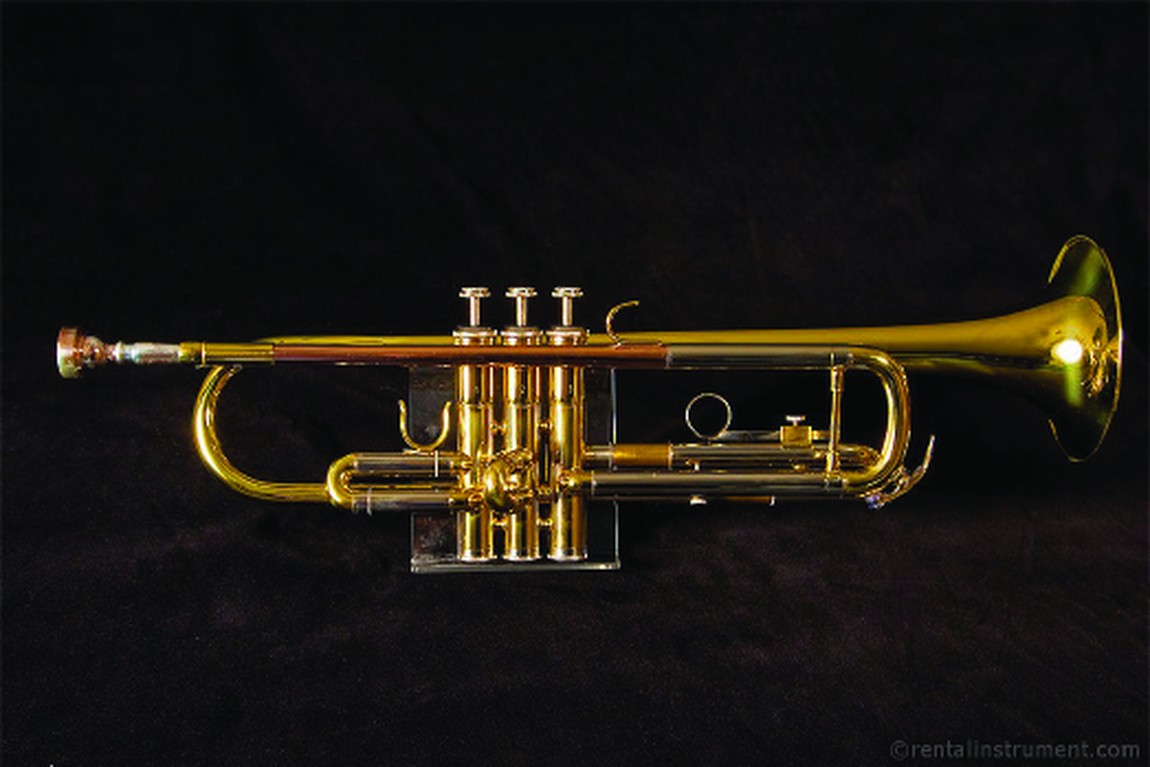
Our four trumpet lines
Every trumpet we rent goes out ready to play. The lines are not ranked against each other. They differ in what the instrument is, not in how it is cared for. More about our band instruments and lines.
A Line: our house trumpet, brand new
Brand new, still sealed from the factory. Never played, never rented, not a scratch on it. Our house trumpet is built to specifications we set, written to match or exceed what the major brands put into their student models.
It is built on the same student designs the big-name brands use, in the same manufacturing world that now builds for the famous names too, and our own musicians vetted the model before we stocked it.
Rent it for three school years and it is yours to keep. It carries no brand marking, which is deliberate: once the instrument belongs to your family it should not be stamped with the name of the company you rented it from.
B Line: the name brands
Before house instruments existed, this is what every shop rented, and it is still what many families picture: a recognized manufacturer with a familiar name on the bell. Some directors ask for one specifically.
These have been played before, and they are well-known brands like Bach and Yamaha. We buy them individually rather than by the crate, and each one is restored on our bench and inspected before it goes out again.
If your director has asked for a particular manufacturer, tell us and we will say what we have and what we can find.
C Line: our house trumpet, restored
The same house trumpet as our A Line, back from a previous rental and rebuilt by our technicians. A technician sits with each one and makes the playability adjustments a factory production line does not stop to make.
It is the least expensive way to get a student started. If you are collecting at our shop and would rather have a different one, say so and we will swap it while you are there.
Premium Yamaha Line: Yamaha YTR-2330
Among brand-name instruments, Yamaha is the standard, and the YTR-2330 is the model school trumpet programs most often specify.
A limited collection, and it does not restock quickly. If a Yamaha is specifically what you want, this is the way to be sure of getting one.
Not sure which to choose?
Choose A Line if you want a new instrument and intend to own it after three years.
Choose B Line if you or your director want a recognized manufacturer.
Choose C Line if your priority is the lowest cost to get a student started.
Choose the Premium Yamaha Line if a Yamaha is specifically what you want.
These are suggestions rather than requirements. Call us and we will tell you what is currently in stock in each line.
Rent for three years and the trumpet is yours to keep.
Keep an A Line rental going for three years and the trumpet becomes yours for life, with no balloon payment and no buyout decision to agonize over. Want to own it sooner? You can purchase at any point with a 10% discount on the remaining balance. And if your student moves on to something else after a year, you simply return it.
A Line only · Yours after 3 years · Also on trombone, baritone and French horn, flute, clarinet, alto & tenor sax
Everything your student needs for day one of band.
Whichever line you choose, the rental arrives complete, no extra trip to a music store before the first rehearsal.
- The trumpet, new or shop-restored, depending on your line
- Hard case
- Mouthpiece
- Valve oil
- Name tag
Valve oil runs out, it’s the one consumable a trumpet needs, and a bottle is inexpensive. Slide grease is worth picking up too.
Valve oil: the thing nobody explains to band parents.
A trumpet has three valves that have to move fast and freely. When they slow down or stick, playing becomes impossible, and it’s almost always because the valves are dry, not because the horn is broken.
- Oil the valves a few times a week. Unscrew the valve cap, lift the valve partway out, put a few drops on the exposed surface, and drop it back in. It takes a minute.
- Grease the slides. Different product, different job, slide grease is thicker and keeps the tuning slides moving. Valve oil on slides doesn’t work; grease in valves doesn’t either.
- Wipe the excess off the outside. Oil and grease build-up corrodes the metal over time, so a quick wipe with a cloth after oiling matters.
- Sticking valves usually aren’t broken valves. Oil them first. If they still stick after oiling, bring the trumpet in, a valve can be misaligned or the casing may need cleaning, and that’s a free adjustment.
Looking after a trumpet.
Brass is forgiving, which is why trumpets survive middle school. The damage we do see is nearly all preventable.
The routine
- Oil the valves a few times a week, more if they’re playing daily.
- Grease the slides when they start to feel stiff.
- Wipe the horn down after playing to remove excess oil, grease, and fingerprints.
- Empty the water key (the spit valve) after each session.
- Back in the case, every time. It’s the safest place for it.
The mistakes that cost money
- Never force a stuck mouthpiece. Twisting or yanking it damages the leadpipe. There’s a proper tool for removing one and we have it, bring the trumpet in and it takes a minute.
- Don’t drop it on the bell. Dents in the bell throat affect the sound and are the most common brass repair.
- Don’t eat or drink right before playing without rinsing, sugar in the horn is what turns into gunk in the valves.
- Skip the metal polish. It wears through the lacquer.
★★★★★
“I used these instruments for several years in the classroom and on stage. As for quality of construction, the trumpet I used held up as good or better than brands twice as expensive. It was also a pleasure to see how free these instruments played in the hands of a beginning instrumentalist, it certainly made my job a lot easier.”
Michael Strange
Professional trumpet player · Band Director, Greenwich Public Schools
Trumpet rental questions
Answered by the luthiers and technicians who repair these every day. Browse all trumpet questions.
My child has braces. Can they still play a brass or wind instrument?
Usually yes, but the honest answer is that it depends on the child, because every mouth is different and so are the braces. Most students play straight through, with orthodontic wax on the brackets and a few weeks of patience, and the orthodontist is worth asking alongside the band teacher. Traditional steel brackets, Invisalign, and lingual braces (mounted behind the teeth) each interact with a mouthpiece completely differently. Our founder had lingual braces and played trumpet without a problem. Another student with the same instrument and front brackets might have a rough month.
How do I clean a trumpet?
The short version: empty the water key and wipe the horn down after playing, oil the valves a few times a week, work the tuning slides with fresh grease monthly, and give it a full bath about once a year, which is worth letting the shop do.
How do I tune a trumpet?
The main tuning slide, the large U-shaped one nearest the mouthpiece end, sets the overall pitch: out to flatten, in to sharpen. Warm the horn up first, because a cold trumpet plays flat and you will chase your tail adjusting an instrument that just needed a minute of playing.
The mouthpiece is stuck in the trumpet. How do we get it out?
Bring it to us or to the band director. A purpose-made tool called a mouthpiece puller removes a stuck mouthpiece in under a minute without leaving a mark, most band rooms and every competent shop have one, and it is a while-you-wait fix. What you must not do is twist it out with pliers. Put down the pliers. Please.
My child’s trumpet valves are sticking.
Sticking valves are nearly always dry, not broken. A trumpet's pistons need oil a few times a week, not once a term, and most sticking valves are simply overdue.
Questions every rental family asks
Should we rent or buy our child’s first instrument?
Rent, in almost every case: beginners can't yet handle an instrument safely, children outgrow sizes and switch instruments, and renting turns those surprises into a phone call instead of a buying mistake. And we would say that even if we didn't rent instruments.
What happens if my child quits after a few months?
Then you return the instrument. That is the whole point of renting instead of buying, it happens in every school year, and nobody here will make it awkward.
Will I be charged for normal wear and tear?
No, not for normal wear: strings wearing out, rosin used up, bow hair breaking strand by strand, a case zipper giving out. That is expected, and it is never charged to you. Damage is different: dents, cracks from drops, a broken bow, carved initials. We always tell you which side of the line we think something sits on before any chargeable work happens, and the insurance exists for the genuine accidents and the gray areas.
Ready to rent a trumpet?
Start the rental online and we’ll follow up within one business day. Free delivery to schools across Connecticut and New York in the fall. Nothing is charged until we confirm.